Courtesy of CoverUps.com
There are two things which are absolutely vital in ensuring organisational success:
1) Hire the right people.

Courtesy of CoverUps.com
There are two things which are absolutely vital in ensuring organisational success:
1) Hire the right people.

Courtesy of “Shanty” Cheryl
As we start a fresh new week, I thought its useful to consider for a moment how we can do things differently. It doesn’t have to be a huge paradigm shifting, game changing milestone, but just a smallish innovation that defies conventional wisdom. And nope, these aren’t New Year resolutions or anything as noble as that. However, they can apply equally at work, at home, at school, at church, or anywhere else.
The idea behind this is to gradually improve in baby steps which are less daunting than taking a huge leap into the unknown. They can be as small as replacing an unhealthy breakfast item (say fried bacon) with a healthy one (say a slice of guava), or perhaps slightly larger – like reading at least 15 minutes to half an hour every day. Doing something small and easy allows one to pick the low hanging fruits, boosting one’s morale and equipping one towards larger and bolder pursuits in life.
For me, I’m going to try to blog at least once every other day, no matter how tired, busy or lazy I feel. Writing gets better the more you do it, and the only way to open that tap is to just keep turning it.
If the spirit is willing but the flesh is weak, forget about moving the world. Instead, begin by moving that itsy bitsy little obstacle in your life first.
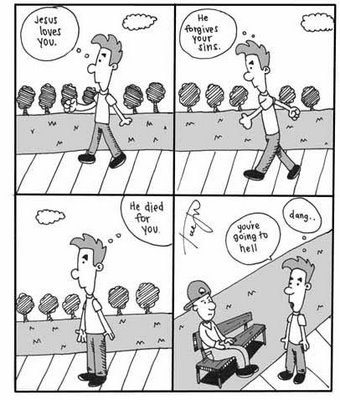
Advocacy Gone Awry (Courtesy of Taejin “TJ” Moon)
I chanced upon a brilliant post by Jeremiah Owyang, renowned web strategist and thought leader, on Advocacy Marketing. This new form of Word Of Mouth marketing is different from the traditional areas as advocates are like members of your inner circle – your best customers so to speak.
Quoting from Jeremiah:

Surprising Them May Be Better Than Satisfying Them (Courtesy of Anthony Cain)
In many B-schools, the mantra for marketing goes something like this:
Do surveys and profile studies to determine what your target customers prefer.

At the kind invitation of HP/Microsoft through Waggener Edstrom, I attended a panel discussion and ideation exercise titled “Future Is: The Online Community Talks About the Future of Things”. Held at the Giraffe Restaurant at the Istana Park across the road from Plaza Singapura, it was attended largely by bloggers, tech entrepreneurs, and students with a new media interest.
Featuring purveyors of tech like Daniel Tsou of Tech65, Willis Wee of Penn Olson, Nicholas Aaron Khoo of C-Net Asia’s Geekonomics, fashion blogger/editor Mina Sunico and Brian Ling of Design Sojourn, the session was a good refresher for me on what’s new and what’s hot in the world of technology.

Dubai was all about the dream without the reality, and landed itself with a huge debt. (courtesy of Bobesh)
There are two school of thoughts in marketing. The first belongs to the world of imagination while the second is centred on pragmatism. Do these spheres of marketing always have to sit on opposite poles?
Let us look at this in some detail.
To succeed in the art and science of marketing, one cannot simply stick to one central approach and hope to wing it come what may. What’s needed instead are a mix of both long-term, medium-term and short-term views. The adoption of these perspectives should vary depending on one’s vantage point.
For a start, one should have a clear long-term vision of the goal and desired end point. What are the overall objectives of one’s marketing efforts? Heightened customer satisfaction? Improved profits? Greater sales turnover? Or stronger brand positioning? Deep in the trenches of marketing skirmishes and battles, one should never forget what the end goal is.
Next, one should look at the medium-term strategies that are needed to accomplish that. What would be the few projects spanning several months to year that should be considered? These could be the development of new products, refurbishing of shop-fronts, training of staff in new areas, organisation of events, or upgrading of service levels.

Transitions are like the rainbow which appears after the storm (courtesy of pleem1983)
Everybody goes through transitions every now and then. Some are overjoyed by the experience. Others become truly terrified. These transformative phases molds and metamorphoses one, changing one either in a positive or a negative manner.
Transitions are the rites of passage which marks the end of one stage and the beginning of another. They are the indistinct stages of limbo, where one grapples with issues of identity and self-worth, while gearing up for a new role in life. Like the refining fire of a goldsmith, they can be hot and bothersome. However, they do lead towards a fresh understanding of what one’s goals and values are, making one see better in the long road of life.

Competing in a crowded marketplace requires the 4 Rs (Shinjuku courtesy of William Bullimore)
What are the most important ingredients in any successful business?
Is it the ability to stimulate Recognition deep, far and wide, penetrating into every household (or organisation) in the land?
Located northwest of Melbourne city, Ballarat was famous for being a mining town, and the site generated the greatest amount of gold during the Victorian Gold Rush of the 1850s. The city occupies an area of 740 square kilometres and houses an estimated population of over 88,000, and has a mixture of Victorian-era architecture interspersed by modern day buildings. Considered one of the state’s premier tourism destination, Ballarat attracts some 1.8 million day trip visitors and about 13% of Victoria’s annual 1.1 million overseas visitors.
Taking a walk along the streets and roads of Ballarat, one can’t help feeling that it has retained much of that old world small town charm of a bygone era, while still modernising itself. The streetscape is vastly different from Melbourne as you may have guessed, and while vestiges of gold-generated opulence can be seen in its buildings, most are classically elegant rather than overtly ostentatious.
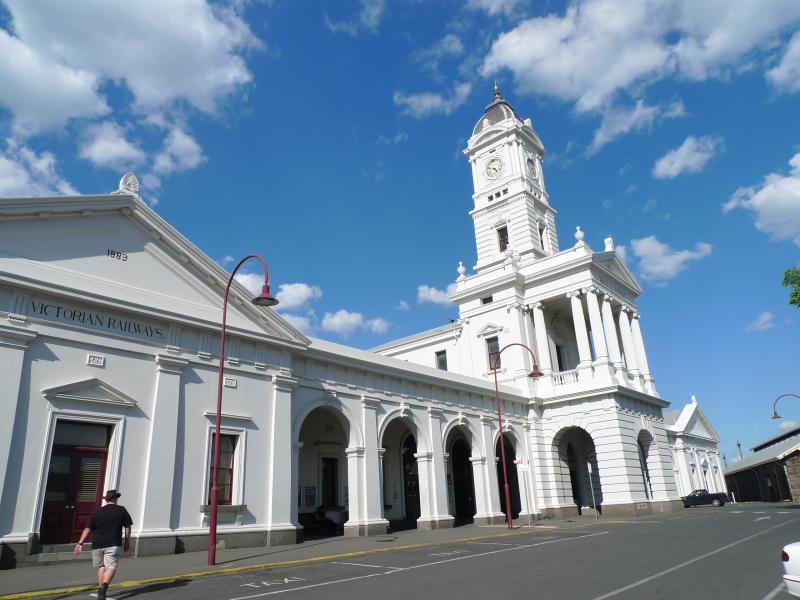
The Ballarat train station built in 1862 is the first place to check out. One can see that the name Victorian Railways befits the regal look of this building. The V-Line train from Melbourne stops here.