
Effective positioning is the difference behind great and average brands. With the right brand and product positioning, your products and services can easily stand out from the competition.
Unfortunately, many companies get it totally wrong—at least according to positioning expert April Dunford.
In her book Obviously Awesome — How to Nail Product Positioning so Customers Get It, Buy It, Love It, Dunford highlights that weak positioning results in…
- Confusion amongst prospects
- Longer sales cycles
- Poorer close rates
- Higher customer churn
- Price pressure
So how can you position your brands and products more precisely and accurately? Let us look at some of the salient points from the book!
What is Positioning?
First, let us define what positioning is.
According to the classic book Positioning: The Battle for Your Mind by Al Ries and Jack Trout, positioning is an “organized system for finding windows in the mind. It is based on the concept that communication can only take place at the right time and under the right circumstances.”
Dunford further associates positioning with context setting for products. Quoting from her book:
“When we encounter something new, we will attempt to make sense of it by gathering together all of the little clues we can quickly find to determine how we should think about this new thing. Without that context, products are very difficult to understand, and the whole company suffers…”
Positioning is critically important in any company because it influences everything else—marketing, communications, product development, sales, and customer fulfillment.
Problems with Bad Positioning
Positioning fails when we aren’t deliberate about positioning our brands and products.
There are two traps that you should be mindful of:
- You are stuck on the idea of what your company builds, but your product is something else
- You designed your product for a market, but that market has changed
As an example, you may think that you’ve built the best low-cost business hotel—no frills, fast wi-fi, desk with universal electric plugs, no TV. However, the market may perceive it to be the perfect accommodation for “premium” backpackers!
How do you address a case of poor product positioning?
Reposition your brand! Learn how below.
The 5 +1 Parts of Effective Positioning
Enter the five-plus-one parts of effective positioning, which are as follows.
#1 Competitive alternatives
What would customers consider as viable options if your solution isn’t around in the market?
For instance, if they didn’t use your accounting software, they could be using paper forms, excel, or a competitive accounting software.
#2 Unique attributes
Unique attributes are the special capabilities or features that only you have.
For service based businesses (eg consultancies, trainers, agencies), they could include a combination of your experience and expertise.
These could also be considered as your differentiators.
#3 Value (and proof)
The value is the set of benefits that your brand can deliver to customers because of your unique attributes.
It provides prospects with the impetus to care about your product’s unique attributes.
#4 Target market characteristics
There are the qualities that you can find in your ideal customers, aka your targeted customer profile.
You need to identify what makes these customers love your products. Why would they care about the value that you bring? More importantly, how do you find them?
#5 Market category
This is the frame of reference for your potential customers, and it acts as a convenient shorthand for customers.
For instance, in my trade, the market categories would be “digital marketing agency” or “digital marketing trainer”.
#6 (Bonus) Relevant trends
If you’re able to ride on a market trend, your brand will be perceived more favourably by prospects.
This doesn’t just have to be about disruptive technologies. Market trends may include changing consumer tastes, product designs, or emerging threats.
Summary of the 5 + 1 points of effective positioning
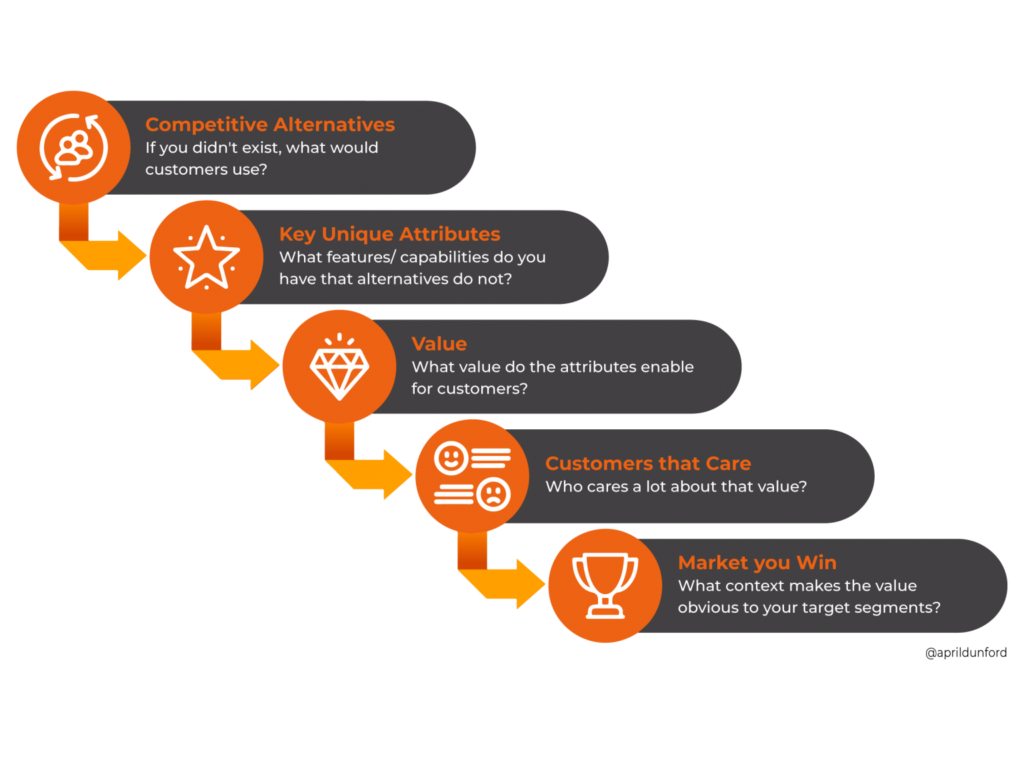
These 6 points of effective brand and product positioning is summarized in the infographic below:
Courtesy of April Dunford
- Competitive Alternatives: If you didn’t exist, what would customers use?
- Unique Attributes: What features/capabilities do you have that alternatives lack?
- Value (and Proof): What value do the attributes enable for customers?
- Target market characteristics: Who would care alot about that value?
- Market category: What context makes your value obvious to these target customers?
- (Bonus) Relevant trends: What trends make your product relevant right now?
A Powerful 10-Step Positioning Process
Let us now look at Dunford’s 10-step formula for repositioning your brand or product.
#1 Study Existing Customers Who Love Your Product
Who are your best customers, and what’s common about these super-happy clients?
Shortlist and see if you can find any similar characteristics in them. Use them as a reference for your exercise.
#2 Assemble Your Product or Brand Positioning Team
Find the people responsible across your organisation—brand managers, product R&D, marketing, sales and business development, customer experience, etc.
Make sure that you appoint a senior business leader for this process!
#3 Get Everybody Up To Speed
This entails equipping everybody with the right positioning concepts and definitions, while simultaneously discarding outdated notions.
Tackle the following topics:
- What positioning is all about
- Why is positioning important
- Which components make up a position (see 5 + 1 above)
- How market maturity and competition influences how you position your product
- Old ways of thinking about your product (“positioning baggage”)
Get agreement amongst the team that the original product created for a certain market and audience may no longer be best positioned that way.
#4 List Your True Competitive Alternatives
Be honest about who your competitors could be, and list them all down. If you’re unsure, ask your best customers for their opinions!
#5 Define Your Unique Attributes or Features
Zoom in on the unique capabilities, features or attributes that the alternatives do not have.
These may be patented features, experience with certain markets, unique skills, list of clients, etc.
Make sure that you have proof—certifications, awards, media reports, customer reviews, or proprietary processes.
#6 Group Your Attributes into Value Themes
Articulate how your product features are translated into customer benefits and value:
- Feature: Something your product does or has, eg Solidly cast from a single mold
- Benefit: What the features enables for customers, eg Greater stability and durability
- Value: How this feature maps to a goal the customer is trying to achieve, eg Lasts three times longer, allowing savings of $80,000 per year on equipment replacement
From your list, see if there are ways to group together attributes that provide a similar value. Quoting from the book:
If you have attributes like “works on any device” or “works without an internet connection,” those might both provide value to customers who would like to use the solution with remote field workers. Thus, you could clump those attributes in a group called “supports remote environments”
#7 Determine Who Your Best-Fit Customers Would Be
Now see if you can find which customer segments would fit into what your product delivers vis-a-vis other alternatives.
There are several pointers that Dunford recommends here:
- Consider actionable segmentation—lists of a person or company’s easily identifiable characteristics that make them really care about what you do. For instance, because of their jobs, the way the make their products, or the skills they have or don’t have.
- Focus on your “best-fit” customers as they are easier to sell to and retain. They’ll be those who understand your product immediately, bought quickly instead of asking for a cheaper price, tell their friends about your product, and do not churn!
- Target as narrowly as possible to meet near-term sales objectives. Go broad later.
#8 Find Right Market Frame of Reference—Put Strengths at the Centre + Decide How Its Positioned
Choosing the right market reference entails opting for something that already exists in the minds of your customers.
- Use abductive reasoning, ie “if it looks like a duck, swims like a duck, and quacks like a duck, then it probably is a duck.” What types of products typically have those features? What category of products typically deliver that value?
- Study adjacent markets, especially when there are overlapping lines between these markets.
- Ask your customers, but be sure that they are those that would think like your prospects.
There are three ways to isolate, target and win a market:
a) Head to Head: Positioning to Win an Existing Market
You aim to be the top dog in a market category that already exists. Prospects understand their purchase criteria (what to consider in making a purchase), and you have incumbents who are competitors in that space. Here, you are claiming to be better than most, if not all competitors.
The head-to-head style is suitable for market leaders or big companies that can muscle your way in. You don’t have to do much customer education. Instead, your job is to show that you are the best in delivering on the criteria that matter.
Be prepared for bloody battles if you choose this approach!
b) Big Fish, Small Pond: Positioning to Win Subsegment of Existing Market
For smaller startups, consider carving out a piece of the market where rules are a little bit different—just enough to give your brand an edge over the category leader.
You can choose subsegments to win based on:
- Industry (eg B2B vs B2C, or retail vs F&B)
- Geography
- Company Size (MNCs vs SMEs vs start-ups vs freelancers)
The benefit here is that you have a well-defined prospect without the overwhelming competition. Also, word-of-mouth marketing tends to happen more often in a niche market subsegment.
Use the Big Fish, Small Pond style when you have a clear market category, defined customer groups (subsegments) with unique needs not met by incumbents, an easy way to identify these subsegments, and a way to demonstrate that this subsegment has very specific and important unmet needs.
c) Create New Market Category
This should only be used when all else fails, ie when you’ve evaluated every possible existing market category and your offering cannot be differentiated or perceived to be valuable to prospects.
To create a new market, you need to ride on the following:
- New technologies
- Economic shifts
- Political changes
- Consumer preferences
As this could be the most difficult style of positioning, you need to invest in teaching your customer. Why is their problem unique? Why do existing solutions fall short? How can they best evaluate solutions in that category? Why are you the best vendor?
Here, you’ll need a “product that is demonstrably, unarguably new and different from what exists in other market categories.” Do also make sure that you have a long-term plan to defend yourself as the category leader, as competitors with more resources and name-brand recognition will be quickly nipping at your heels!
#9 Ride On a Trend (Carefully)
Think about how your product’s strengths, your market context, and a trend can overlap.
Make sure that the trends have a clear link to your product. For instance, Non Fungible Tokens (NFTs) and Artificial Intelligence (A.I.) may be all the rage now, but how are these trends relevant to your home cleaning services?
Note that it is “better to be a little boring than completely baffling.”
#10 Document Your Positioning and Share It
Make sure that you capture your positioning (or repositioning) and share it across your organisation.
This will be used to inform branding, marketing campaigns, sales strategy, product decisions, customer-success strategy and a lot more.
A good way to do so is to use a Positioning Canvas like the one below from April Dunford’s book.
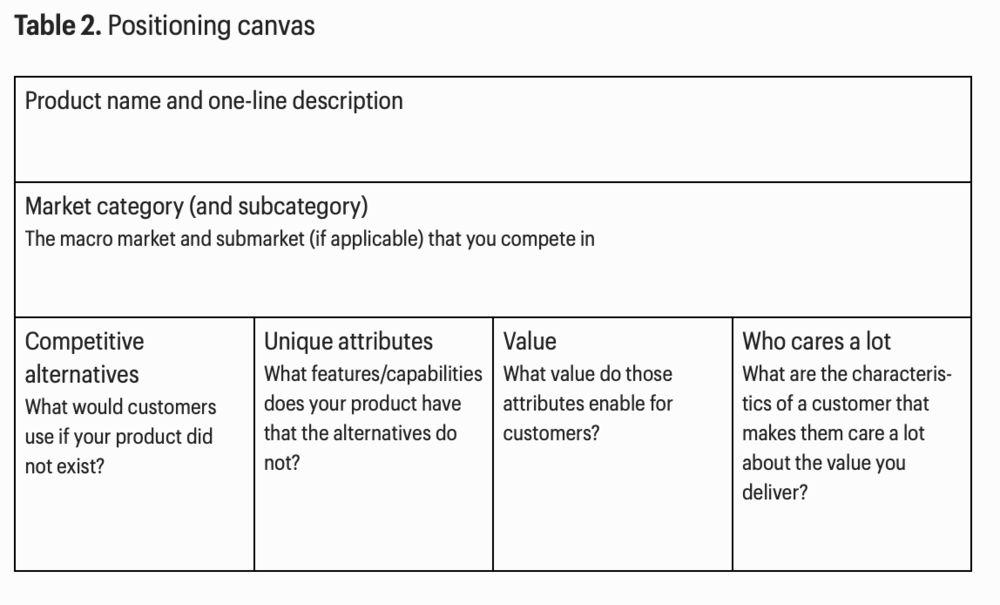
Write down your product name and description, market category (and subcategory), competitive alternatives, attributes of your product, the value it brings to your customers, and characteristics of your prized customer segments.
Conclusion — A Great Way to Implement Effective Positioning
Short and succinct, yet packed with value, Obviously Awesome does live up to its name.
What I’ve described in my book summary above are just some of the salient points, do get the book (and download its templates) to learn a lot more.
I’ll certainly be implementing some of these measures for my clients and maybe even my own company. What about you?
