Wish to get better results in your online or offline marketing efforts? Consider asking DAD!
No, I’m not asking you to consult your father figure for marketing advice—unless he happens to be a marketing expert.
What I truly meant is that you need to have a marketing framework that helps you to stand out from the crowd.
One that focuses on positioning your business, service or brand to “get noticed, attract the best prospects, and convert opportunities into sales.”
The D.A.D. Marketing Framework
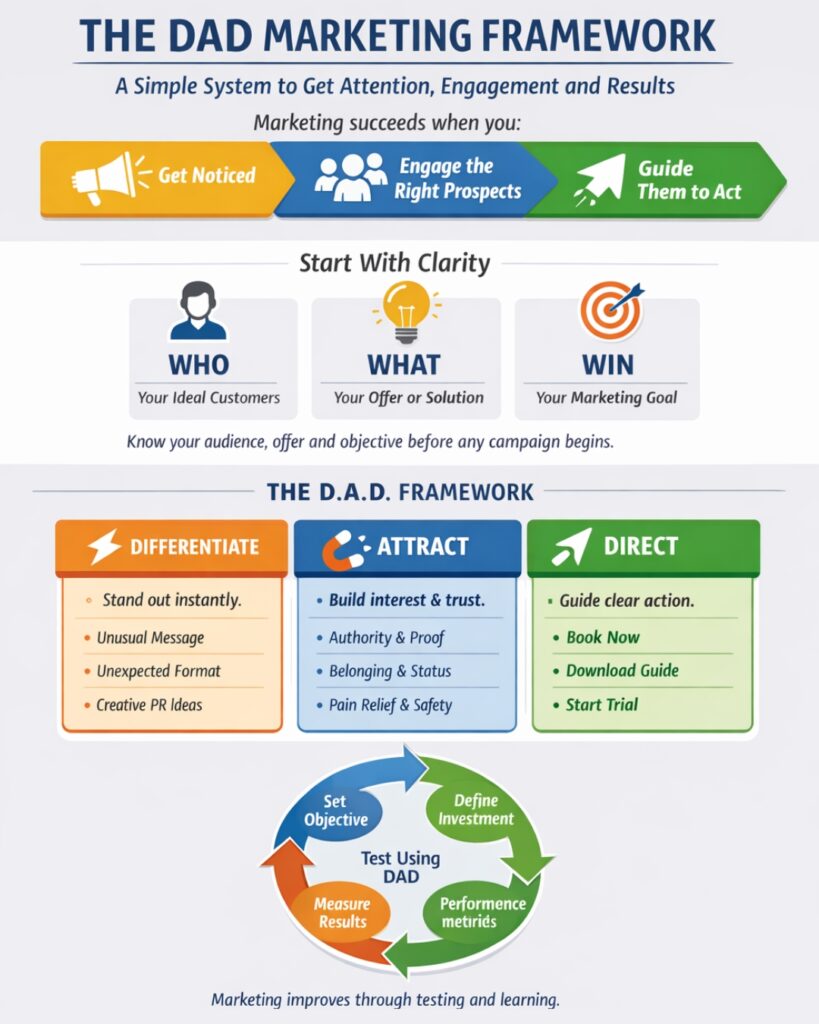
Introducing the DAD Marketing Framework created by Mike Michalowicz (author of The Pumpkin Plan), which is broken down into three components:
- DIFFERENTIATE: How do you attract attention in the first milliseconds, by presenting something uncommon, unknown or unexpected to your prospect.
- ATTRACT: How do you engage your prospect by demonstrating, exhibiting, or expressing an opportunity or benefit to them.
- DIRECT: How can you direct them to comply, by specifying a reasonable and specific action that they need to take to get closer to or gain the opportunity/benefit.
This is summarized by the infographic below.
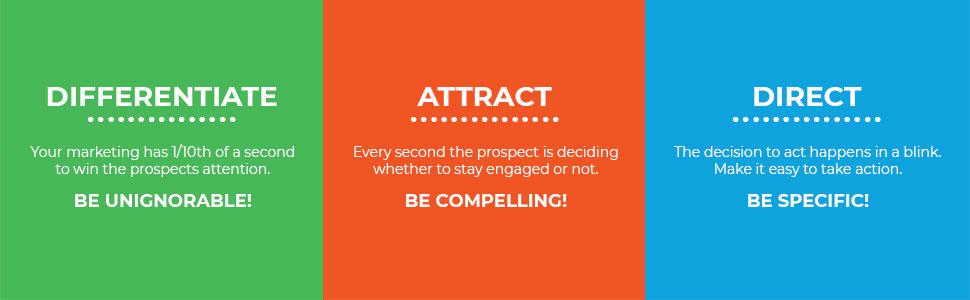
Courtesy of Amazon
Introduced in his new book Get Different: Marketing That Can’t Be Ignored, the goal of DAD can be summarized in a single sentence:
Do different to get noticed in a way that attracts your ideal prospects and directs them to act.—Mike Michalowicz
Before we venture into the details of the DAD Marketing Framework, let us first zoom in on very important questions.
Who, What, and Win
To succeed in marketing, you need to know the answer to three important questions:
- Who: Who are your ideal 100 customers? Print out current customer lists, determine their lifetime value (LTV), as well as how you feel towards them. If your business is new, develop a detailed customer avatar.
- What: What is your offer to these customers? What exactly do you sell? Write it down!
- Win: Your goal in marketing: acquire customer, retain customer, improve repeat purchases, generate leads, sell products, etc. Write this down too!
Beyond getting the answers to these three questions, you’d also need to determine your marketing investment:
- Customer LTV: What is the lifetime value of your customer?
- Close Rate Odds: What are the percentage of prospects that you can close, with your best effort?
- Investment Per Prospect: How much should you spend for each marketing effort to get these customers? This may also be known as your Customer Acquisition Cost (CAC).
You can download FREE resources from Mike Michalowicz’s website here to guide you along in this journey.
#1 Differentiate to Gain Attention
How can your business stand out from the crowd? Here are some of the more noteworthy ideas from the book:
- Switch Medium: Go offline if your competitors are online, and vice-versa. Send prospect a physical gift—with no strings attached!
- Mine Ideas: Ask five people (different backgrounds) for ideas, by giving them info on your customer avatar, product/offer, problem that it solves for the avatar, and typical way your competitors market.
- Ordinary & Obscure: List typical product features and benefits, as well as how its used. Thereafter, consider how you’d market if: its to a single person; only one feature/benefit; an atypical feature; why people should not use your product; what your product doesn’t do.
- Uncover Your “Est”: Anything superlative and quirky you can highlight? Eg Weirdest, naughtiest, silliest, tannest, yummiest, goofiest, cheekiest, edgiest, etc? (I consider myself as the geekiest marketer!)
- Blend Industries: How do circuses or clowns market themselves? What about movies? Can you blend this in your marketing?
- Find Opposites and Loopholes: What is standard in your industry and how can you do the exact opposite?
- Think like Reporter: Can you pull a PR stunt to get attention?
There are a lot more techniques in the book. Get it to read for yourself.
#2 Attract to Improve Engagement
After getting your prospect to sit up and pay attention, you need to sustain their attention. This is done by using attraction influencers which are basically techniques to bring them over to your side.
Let’s look at some of them.
a) Authority and Trust
Position yourself as a leader in your field, in terms of your knowledge, experience, capabilities or influence. If you don’t have direct experience in a field, show that you can be trusted (perhaps with reviews and testimonials).
b) Repetition
The more you hear something, the more it attracts. Phrases and facts that are repeated often enough sometimes feel more trusted.
c) Social Significance
Tap on how your product or service can make your prospect a better version of themselves. Eg “get praised by your boss for improving your digital marketing results!”
d) Alignment
This is focused on the confirmation bias of your prospect—their tendency to favour things that they already believe, or discredit/ignore things that they don’t.
e) Safety & Comfort
Both of these are basic levels that people seek (remember Maslow’s Hierarchy of Needs?), and can be used as attractors in your marketing messages.
f) Expansion/ Status Upgrades/ Esteem
We’re all looking at upgrading ourselves. Likewise, consider how you can appeal to the status improvements for your prospect.
This may also include ways to improve your prospect’s self-esteem (something that many cosmetic and beauty brands do).
g) Belonging
Can you get them to feel connected to a specific community? What can make them super fans?
h) Health & Beauty
What can you do to improve the health and beauty of your prospects?
i) Pain Relief
Consider the specific physical, emotional or mental pain that your product or service can alleviate.
Beyond these factors, do also ensure that your marketing offer fits your prospect’s identity, and is offered at the right time, place and channels for your prospect. (More on marketing context here.)
#3 Direct to Get Results
The final step is simply your Call To Action (CTA).
This should be simple, easy to do, and pain-free—the fewer hurdles that your prospect needs to jump over, the better.
Examples may be as follows:
- Download your FREE resource here
- Book your limited time trial today
- Get yours at 20 percent off now
- Subscribe to our newsletter
- Try it for yourself now
When thinking about your CTA, consider your positioning relative to your community:
- Someone Superior: If they aspire to be like you, learn from you or gain from you, issue a command: “Learn from me” or “Buy this product”
- Someone Equal: If you want to position yourself as the same tribe as your community, invite them to “subscribe to our newsletter” or “join our community” or “be part of our membership”
- Someone Inferior: For circumstances where you need their help, consider appealing to them, eg “share your ideas” or “what do you think?” or “tell us how we can help you”
That’s it! The DAD Marketing Framework in a nutshell.
Wait, there’s more…
Conducting Marketing Experiments
To really reap the benefits of marketing differently, you need to conduct marketing experiments. The goal is to find out if it works (or sucks, which is likely to be the case), pivot and improve (or kill idea), and then repeat.
This takes the following steps.
Step 1: Establish Objective
Determine the Who, What and Win of your marketing experiment (see section above). Be as specific as possible.
Step 2: Determine Investment
Develop the budget for your marketing experiment based on the points I’ve raised above: Customer LTV; Close Rate Odds; and Investment Per Prospect
Step 3: Experiment with DAD
Let her rip! Use the DAD Marketing Framework to ask “Does DAD approve?”
- Differentiate: Is your idea unignorable?
- Attract: Is it a safe opportunity?
- Direct: Is it a specific and reasonable ask?
Check all boxes.
Step 4: Measure to Determine Next Steps
Include the following:
- Intentions: Start date; no of prospects; return (eg sales, or leads, or whatever); investment (how much spend)
- Outcomes: End date; actual no of prospects; actual return; actual investment
- Observations: What did you learn from your experiment?
- Verdict: Should you expand and use as ongoing strategy, re-test with new variables, improve, or abandon?
Conclusion
As a marketing framework, DAD is simple, easy-to-execute, and systematic. The various free resources also useful to tap on.
I love how Mike brings the emphasis back to marketing fundamentals of standing out in a crowded marketplace amongst me-too competitors.
For many marketers, our biggest challenge lies is in coming up with creative ideas that can resonate with our target audiences while remaining relevant to our business. To this end, the numerous frameworks and triggers provided in the book serve as excellent starting points for ideation.
What do you think? Would being different work for your particular industry or trade?
Get your copy of Get Different here. Also, check out the infographic below generated with the help of ChatGPT AI!